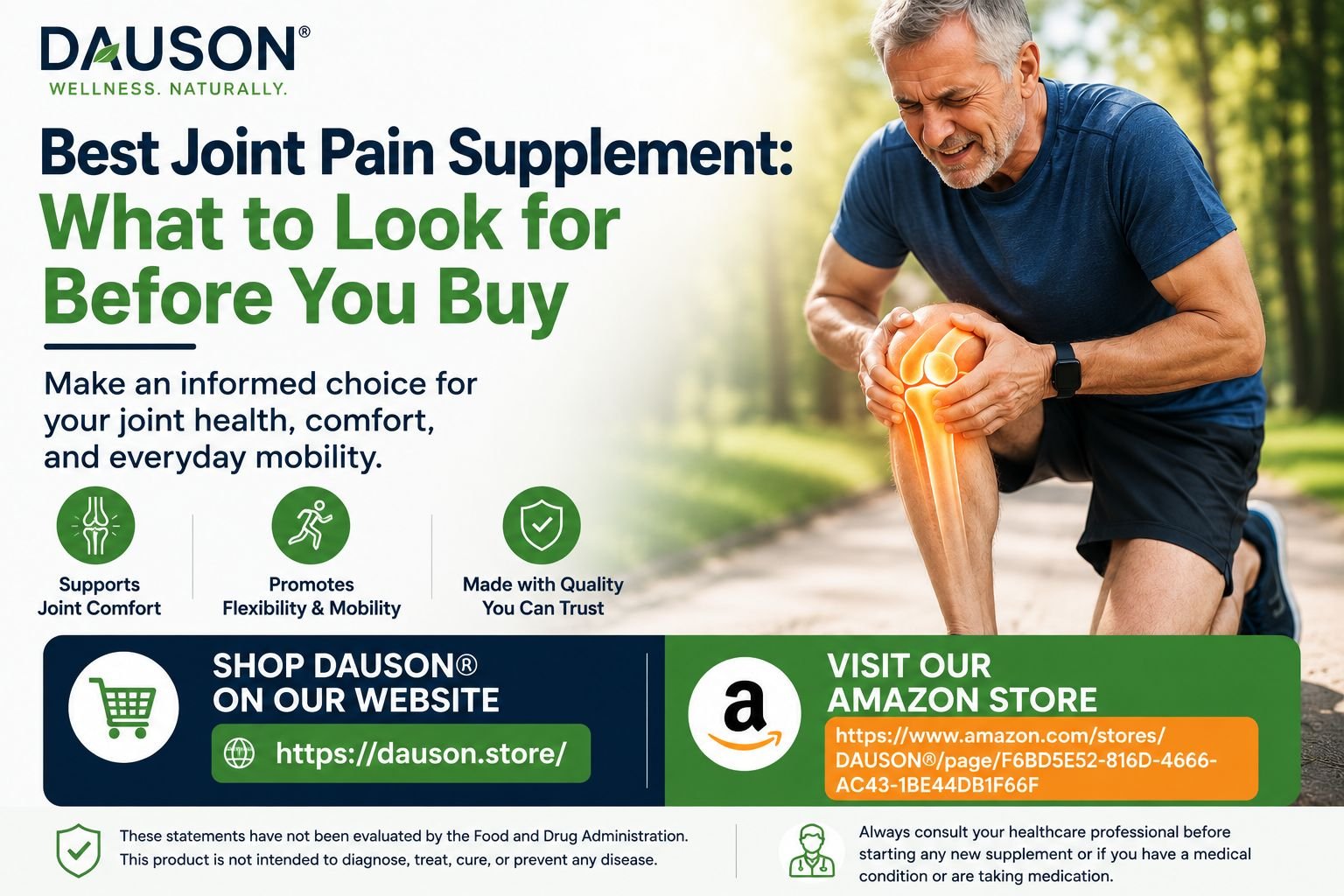

Best Joint Pain Supplement: What to Look for Before You Buy
Joint discomfort can make everyday activities—from walking and climbing stairs to exercising and completing household tasks—feel more challenging. That’s one reason many people explore supplements as part of their approach to maintaining joint health and mobility.
But choosing a joint pain supplement isn’t simply a matter of picking the most popular bottle. Formulas can differ considerably in their ingredients, dosages, quality standards, and intended uses.
Before adding any supplement to your routine, it helps to understand what’s inside it and what the available evidence actually suggests. This guide covers common joint-support ingredients, what to look for on a label, and important factors to consider before buying.
What Is a Joint Pain Supplement?
A joint pain supplement is generally a dietary supplement formulated with ingredients intended to support joint health, comfort, flexibility, cartilage, or normal mobility.
Depending on the formula, products may contain individual ingredients or combinations of compounds such as:
- Glucosamine
- Chondroitin
- Turmeric or curcumin
- MSM (methylsulfonylmethane)
- Boswellia
- Omega-3 fatty acids
- Collagen
- Vitamins and minerals
Supplements should not be viewed as substitutes for medical treatment. Joint pain can have many causes, so persistent, severe, or unexplained symptoms deserve professional medical attention.
Why Do People Use Joint Support Supplements?
Joint health can change with age, physical activity, previous injuries, body weight, and certain medical conditions.
Some people use supplements alongside healthy lifestyle habits in an effort to support everyday joint comfort and mobility.
Individual responses can vary significantly. A supplement that seems useful for one person may produce little noticeable difference for another, which is why ingredient quality and realistic expectations matter.
Ingredients Commonly Found in Joint Pain Supplements
When comparing products, start with the ingredient list rather than marketing claims. Several ingredients frequently appear in joint-support formulas.
1. Glucosamine
Glucosamine is a naturally occurring compound associated with cartilage and is one of the best-known ingredients in joint supplements.
Research into supplemental glucosamine has produced mixed results. Some people report improvements in symptoms, while studies have not consistently demonstrated the same degree of benefit across all users.
Different forms of glucosamine are also available, so consumers should pay attention to the specific form and amount listed on a product label.
2. Chondroitin
Chondroitin is another naturally occurring component of cartilage. It is frequently combined with glucosamine in joint-support products.
As with glucosamine, research findings regarding joint symptoms have varied. Its presence in a supplement does not guarantee that a product will relieve pain.
3. Turmeric and Curcumin
Turmeric is a plant widely recognized for its naturally occurring curcuminoids, including curcumin.
Curcumin has been extensively studied for its anti-inflammatory properties. However, formulations differ, particularly in how well curcumin is absorbed by the body.
If you’re considering a turmeric-based joint pain supplement, check the label carefully rather than assuming all turmeric products are equivalent.
4. MSM
Methylsulfonylmethane, better known as MSM, is an organosulfur compound commonly included in supplements marketed for joint health.
Some research has investigated MSM for joint discomfort and physical function, but more high-quality evidence is needed to establish its effects conclusively.
5. Boswellia
Boswellia serrata is a plant whose extracts have a long history of traditional use.
Modern joint supplements sometimes contain standardized Boswellia extracts. Research has examined their potential effects on inflammation and joint symptoms, although results and formulations vary.
6. Collagen
Collagen is an important structural protein found throughout the body, including in cartilage, tendons, bones, and skin.
Hydrolyzed collagen peptides and undenatured type II collagen are among the forms found in supplements. They are not interchangeable, so checking exactly which type a product contains is important.
7. Omega-3 Fatty Acids
Omega-3 fatty acids—particularly EPA and DHA—are commonly associated with fish oil.
They have been studied extensively in relation to inflammation and general health. When comparing omega-3 supplements, look beyond the total amount of “fish oil” and check how much EPA and DHA the serving actually provides.
How to Choose the Best Joint Pain Supplement
There is no universally best supplement for every person. Instead, look for a product that suits your needs while meeting reasonable standards for transparency and quality.
Check the Full Ingredient Label
A trustworthy label should clearly tell you what you are consuming.
Look for the specific active ingredients, quantities per serving, serving size, additional ingredients, allergen information, and relevant warnings.
Be cautious with products that make it difficult to determine how much of each important ingredient is actually included.
Look for Evidence-Based Ingredients
An ingredient being natural or popular does not automatically mean it is effective.
Before buying, investigate whether the ingredients have been studied in humans and whether the amount in the product resembles quantities evaluated in credible research.
Consider Third-Party Testing
Independent testing can provide additional reassurance about a supplement’s identity, purity, and manufacturing quality.
When a company claims its product is independently tested or certified, check what organization performed the testing and what the certification actually covers.
Avoid Unrealistic Claims
Be skeptical of supplements advertised as a “miracle cure,” an instant solution, or a guaranteed way to eliminate joint pain.
Dietary supplements can play a supporting role for some people, but responsible manufacturers should not present them as guaranteed treatments for diseases or medical conditions.
Compare Value, Not Just Price
The cheapest product is not necessarily the best value, and a high price does not automatically indicate superior quality.
Consider the number of servings, active ingredient amounts, formulation, testing standards, recommended daily intake, and cost per serving.
Can Joint Supplements Replace a Healthy Lifestyle?
Supplements are better considered one potential part of a broader joint-health strategy.
Depending on your health and physical abilities, maintaining joint health may also involve regular appropriate exercise, strength training, maintaining a healthy body weight, getting adequate sleep, eating a balanced diet, and avoiding excessive strain.
For people experiencing ongoing joint pain, identifying the underlying cause is particularly important.
How Long Does a Joint Pain Supplement Take to Work?
There is no universal timeline.
Unlike medications designed for rapid symptom relief, dietary supplements may not produce an immediate noticeable effect. How someone responds can depend on the ingredient, dosage, consistency of use, underlying cause of discomfort, and individual health factors.
Follow the product directions unless your healthcare professional recommends otherwise.
Taking more than the recommended amount in an attempt to get faster results can increase the risk of adverse effects.
Are Joint Pain Supplements Safe?
“Natural” does not always mean risk-free.
Supplements may cause side effects or interact with medications. Certain ingredients may be unsuitable for people with specific medical conditions, during pregnancy or breastfeeding, or before surgery.
It is especially important to speak with a qualified healthcare professional or pharmacist if you take prescription medication, have an existing health condition, or are unsure whether a particular ingredient is appropriate for you.
When Should You See a Healthcare Professional?
A supplement should not delay evaluation of significant joint symptoms.
Seek medical advice for severe or persistent pain, substantial swelling, redness or warmth around a joint, sudden loss of movement, pain following a significant injury, fever accompanying joint symptoms, or discomfort that continues to worsen.
A healthcare professional can help determine what is causing the problem and recommend an appropriate course of action.
Frequently Asked Questions About Joint Pain Supplements
What is the best joint pain supplement?
There is no single joint pain supplement proven to be best for everyone. The right choice depends on factors such as the cause of your symptoms, ingredients, dosage, other medications you take, and your overall health. A healthcare professional can help you evaluate suitable options.
What ingredients should I look for in a joint supplement?
Common ingredients include glucosamine, chondroitin, turmeric or curcumin, MSM, Boswellia, collagen, and omega-3 fatty acids. Evidence and appropriate dosages differ between ingredients, so review each product individually.
Do joint pain supplements actually work?
Research varies considerably by ingredient and condition. Some ingredients have shown potential benefits in certain studies, while others have inconsistent or limited evidence. Results experienced by individual users can also vary.
Can I take a joint supplement every day?
Many products are designed for daily use, but that does not mean every supplement is appropriate for every person. Follow the label and consult a healthcare professional when necessary, particularly if you take medication or have an existing medical condition.
Can I take multiple joint supplements together?
Combining products can unintentionally duplicate ingredients or lead to excessive intake. Check the complete ingredient lists before combining supplements and discuss your regimen with a healthcare professional or pharmacist.
Are natural joint supplements completely safe?
No supplement can be assumed to be completely safe simply because its ingredients are natural. Natural compounds can cause adverse effects and interact with medications.
Final Thoughts
Choosing a joint pain supplement should start with understanding what is actually inside the product rather than relying on bold marketing promises.
Check the ingredients and their amounts, look for transparent quality and manufacturing information, research the evidence behind key ingredients, and be cautious of products promising instant or guaranteed results.
If you’re exploring supplements as part of your wellness routine, you can browse DAUSON® products through our official online stores:
- Shop DAUSON® on Our Website: https://dauson.store/
- Visit the DAUSON® Amazon Store: https://www.amazon.com/stores/DAUSON%C2%AE/page/E6BD5E52-816D-4666-AC43-1BE44DB1F66F
Remember that dietary supplements are intended to complement—not replace—a balanced lifestyle or appropriate medical care. If you have persistent, severe, or unexplained joint pain, or if you take medications or have an existing medical condition, consult a qualified healthcare professional before starting a new supplement.
Ready to Explore DAUSON®?
Discover our selection of supplements and find products that fit your daily wellness routine.
Shop directly at DAUSON®: https://dauson.store/
Prefer Amazon? Visit the official DAUSON® Amazon Store: https://www.amazon.com/stores/DAUSON%C2%AE/page/E6BD5E52-816D-4666-AC43-1BE44DB1F66F